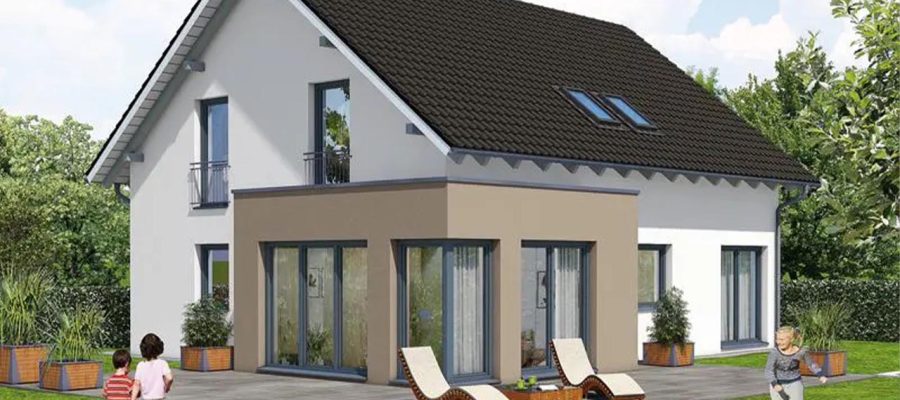
In order for future generations to live in an environment that is as intact as possible, it is important to think about the future today. The federal government’s goal is to make Europe a climate-neutral continent by 2050. Sustainable construction is therefore a big topic of discussion. Materials are compared with each other in terms of their ecological properties and construction methods are evaluated based on their energy consumption. In this article we will show you how environmentally friendly it is to build with our Rötzer brick elements.
Sustainable construction with Rötzer brick elements
Whoever designs a new building today, regardless of whether it is private or public, must take into account not only the financial but, above all, ecological aspects. Sustainable construction is the new status quo. This requires a building material that is of natural origin, but also has properties for energy-efficient use of the building. At Rötzer, we build with bricks that optimally meet these requirements.
Regionally produced bricks
In principle, bricks can be considered natural products because they consist mainly of clay or loam. The latter is also mined locally at our headquarters in Rötz. The bricks we use are produced by the local company Schlagmann Poroton. This way the clay is transported to the production site and the bricks are transported to our factory via the shortest delivery route. So we get almost CO2-free for our building material, which we consider an excellent basis for sustainable construction.
We explain how a brick is made in our blog post “Brick Making: How is a Brick Made?”
The Schlagmann Poroton company is considered one of the leading brick suppliers in southern Germany. With its own climate protection experts in its team, it not only promises climate-neutral brick production, but also supports the protection of species, regionality and biodiversity.
Energy savings through reduced construction times
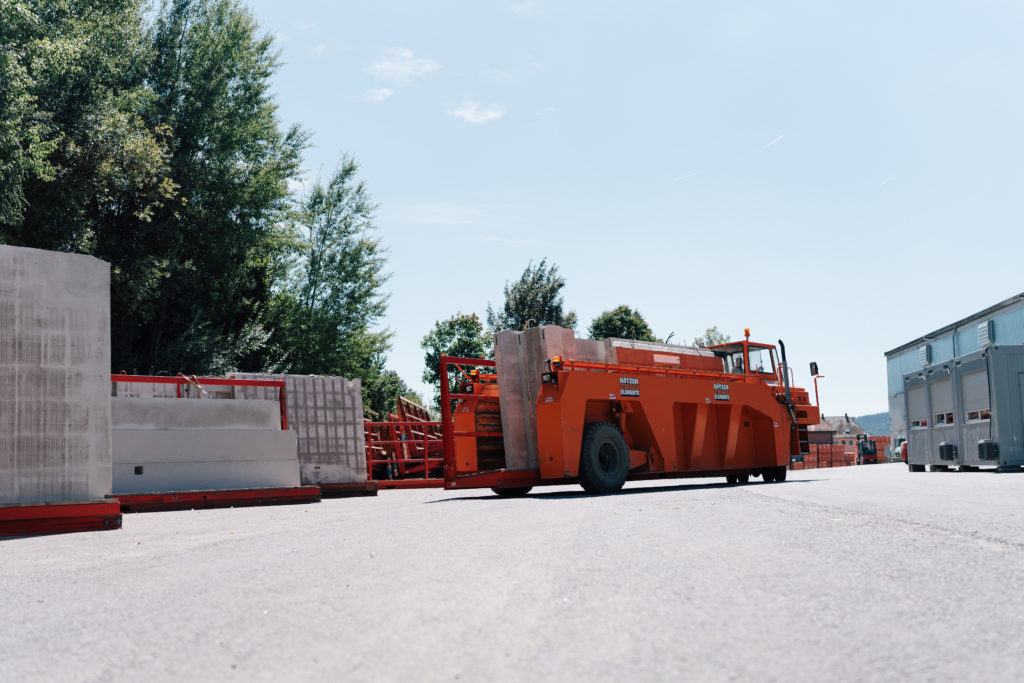
For us at Rötzer, building sustainably means working in the most energy-conscious way possible. This is why we focus on the precision in the production of our brick elements on the one hand and on rapid assembly on the construction site on the other. Our walls are prefabricated right in the Rötzer factory and only need to be assembled afterwards. The whole shell is ready in a few days. Short construction times reduce not only noise on construction sites, but also the operating life of heavy construction vehicles. This effectively saves money, time, energy and CO2.
Do you want to know more about building with brick elements? Our blog post “The advantages of brick element construction” gives you an overview. Please read it.
Rötzer brick houses have a long service life
The term “sustainability” implies covering long-term needs, such that it is not necessary to use new resources for this. This also applies to your own roof over your head, which is why the durability of the building material plays an important role in sustainable construction. Our construction with brick elements is exemplary in this sense. Brick houses are extremely sturdy and durable, do not require any maintenance work on the building structure and maintain an excellent appearance for many years after new construction. The average life of a Rötzer house is approximately 120 years; However, with proper care, a brick building can reach 150 years. In this way, it offers people a reliable home for multiple generations.
Sustainable dismantling: bricks can be recycled
Once the brick house has reached the end of its long life cycle, bricks offer another great advantage: they are recyclable and can be put back into the cycle completely and free of harmful substances. The material can be processed in a recycling center and subsequently used in the production of other building materials or as a stabilizer for the production of new bricks.
Energy-efficient heating and cooling thanks to the Rötzer brick climate ceiling
The less energy that is subsequently used to heat and cool living spaces, the more environmentally friendly the building will be. Our Rötzer brick climate ceiling uses the natural properties of bricks, which absorb heat and radiate it evenly into the surrounding environment. Water pipes are laid inside it, which heat up when heated. The bricks distribute it in the form of radiant energy, which generates heat only when it hits a body. Heat accumulation and dry air in living spaces are now a thing of the past, especially to the benefit of allergy sufferers.
In the hot summer months the climate brick ceiling regulates the temperature according to the same principle. However, the rising heat is dissipated and the cold water in the pipes is used to cool the room. In this way the tiled ceiling regulates the room temperature without consuming much energy.
Curious? In our blog post “Building to save energy: the climate brick ceiling as an effective heating and cooling system” you can find out more about our energy-efficient climate brick ceiling.
For further reading
Do you need further arguments to convince you of our Rötzer houses?
In our article “6 reasons for a brick house: the advantages at a glance” you will find further arguments in favor of a solid house.
latest posts published

The Magic of Flowers from Seeds: How to Grow Beauty from Scratch – Home & Family > Plants

The most beautiful autumn flowers. Perennial plants to have in the garden – Home and family > Plants

Sunflower, romantic and seductive – Home and family > Plants

Plants with good Feng Shui – Home and family > Plants

Which vegetables grow the fastest? 10 varieties to have in the garden – Home and family > Plants
Dwarf roses: color and freshness – Home and family > Plants

How to make potted lilacs last longer – Home and family > Plants
Bayer plants for a green future! – Home and family > Plants
Trees with good Feng Shui – Home and family > Plants