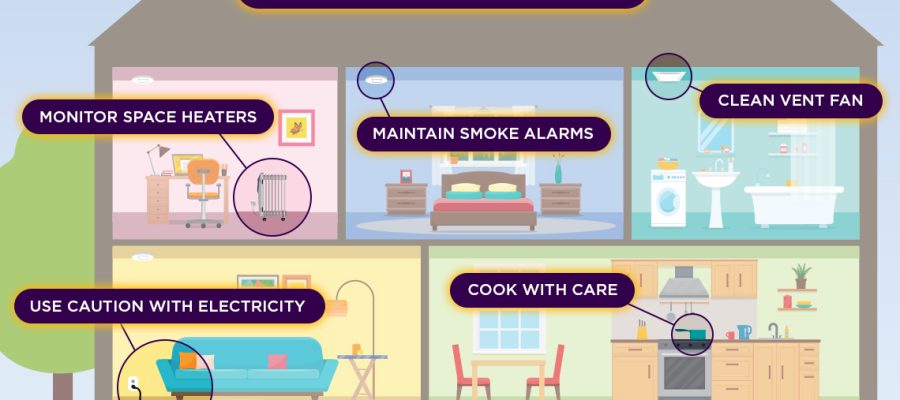
On average, around 200,000 house fires occur in Germany every year. From faulty electrical devices to human error to overheating of the socket: the causes of fires are many. So they are also Preventive measures for fire protection in single-family homes should not be underestimated and in many cases can save lives. Depending on the federal state, there are also regulations laid down in the respective state building regulations. The main objective of fire safety regulations is to protect the lives of people and animals. The templates are also intended to ensure that the fire does not spread into residential buildings, that escape routes are accessible in the event of a fire and that firefighters can reach the source of the fire as quickly as possible and without major problems. We have summarized the most important regulations and standards regarding fire protection for you.
Structural fire protection in single-family homes: regulations and standards
Fire protection regulations are set out in section 14 of the Model Building Regulations of the Urban Development, Building and Housing Working Party. This is not a law, but rather a guide for individual federal states, which adapt their building regulations to it. Even when designing the house Building owners should therefore take a closer look at the fire protection regulations.
Accordingly, for greater safety, homeowners should take the following fire protection measures in single-family homes:
- Use of building materials and components according to their fire classes and fire resistance
- Respect for building distances
- Determination of escape and rescue routes
Building materials and fire resistance classes
The fire behavior of building materials is specified in the DIN 4102 standard. The materials are then classified according to the building material class and the fire resistance class. A distinction is made between two materials: non-combustible materials (e.g. concrete, stone, brick, concrete) and combustible materials (e.g. wood, cardboard, chipboard, plastic)
All combustible materials require labelling, so there must be a reference to the respective class on the packaging. Furthermore, precise information is provided on how long a component will operate in the event of a fire. The regulations for the respective federal states can be found in State building code registered.
Fire safety rules for your home
Detached buildings with a maximum of two floors can be classified in building class 1. In this group there is only small editions. It should be noted that in the event of a fire, residents must be able to be rescued by the fire brigade. Depending on the building materials chosen, there are specifications regarding the minimum distances that must be maintained from other buildings. If the roof is made of easily flammable material, the building must be at least twelve meters from the property line. If the walls are made of combustible building materials or the cladding is made of normally flammable building materials, a distance of five meters from the boundary of the plot and also from other buildings on the plot must be maintained.
Technical fire protection in single-family homes: smoke detectors, fire extinguishers, etc.
Another preventative fire protection measure is the installation of technical systems. This is intended to prevent, signal or promptly combat the occurrence of a fire. As a result, there is a legal requirement for residential buildings to be equipped with smoke detectors. In the bedroom, in the children’s room and in escape routes Fire alarm to be installed to carry out both active and preventive action against fires. A legal regulation and an obligation for Fire extinguisher it currently does not exist at a national level. However, it is advisable to always have a fire extinguisher on hand as a precaution when fighting a fire. Besides, it should Escape and rescue routes are always free and possibly also equipped with emergency lighting.
To prevent fires in your home you absolutely must not skimp on fire prevention measures. Because these investments can save lives in an emergency.
You can find more information about safety precautions at home on our blog.
latest posts published

The Magic of Flowers from Seeds: How to Grow Beauty from Scratch – Home & Family > Plants

The most beautiful autumn flowers. Perennial plants to have in the garden – Home and family > Plants

Sunflower, romantic and seductive – Home and family > Plants
Plants with good Feng Shui – Home and family > Plants

Which vegetables grow the fastest? 10 varieties to have in the garden – Home and family > Plants

Dwarf roses: color and freshness – Home and family > Plants

How to make potted lilacs last longer – Home and family > Plants

Bayer plants for a green future! – Home and family > Plants
Trees with good Feng Shui – Home and family > Plants