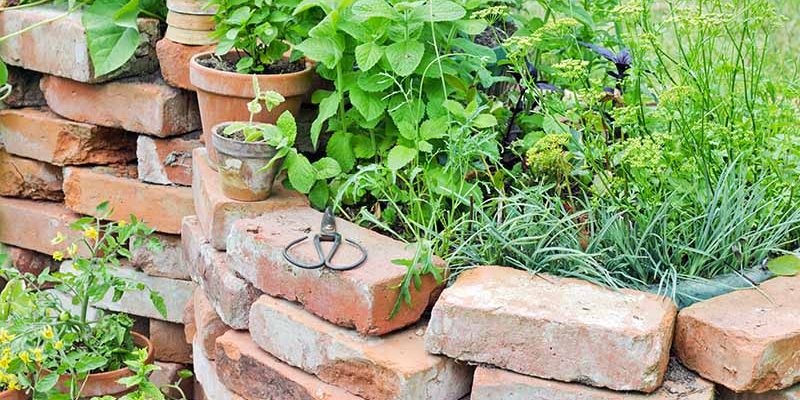
Old bricks have a very particular charm. Whether for interior walls, gardens or as a decorative object, more and more people rely on the historical-romantic atmosphere that comes from the centuries-old building material. Old bricks can be wonderfully integrated as an eye-catcher, especially in the garden. So you still have some old bricks left over from building or renovating your home? Then make something nice with it! A small DIY project in the garden is a great idea, especially in the summer. We have put together three DIY ideas with old bricks for you. You have the choice:
- Old brick bed border
- Romantic garden wall
- Flower pot for succulents
Where do you get the old bricks from?
It’s clear: not everyone has a garage full of old bricks. In this case, you can also organize the popular building material in other ways. An ideal place to find things are, for example, old demolished houses. There, people who collect old bricks themselves can often collect old bricks from the building site or construction waste landfill for free. Just ask once. A hardware store or garden store can also help you with your search. Also search on the Internet or browse your newspaper. In any case, you should be able to find a good deal here. Our advice: Hollow bricks have numerous advantages when building a house and offer optimal thermal insulation thanks to the holes. However, old bricks in monastic or imperial format, which already have a historical and romantic look, are particularly suitable for our DIY ideas.
Here you can also read how brick production works in Statten and what the differences are between bricks, clinker, etc.
Simply make the edge of your bed with old bricks
A bed border made from old bricks is a popular and very simple way to use leftover building material. This creates a clean and decorative cut between the flowerbed and the rest of the garden. And the peculiarity of the brick: it immediately has a decorative appearance and can be laid very quickly. It’s that easy:
1. Determine size and shape
If there is no bed yet, you should first consider the size and shape. Then unplug it briefly. Arrange the bricks according to your ideas. This gives you a better idea of what the bed will look like later. Our advice: Do not sort stones strictly by color, but use them randomly. This ends up creating a very casual DIY look.
2. Dig a trench
Once the bed is staked, you can first dig up the soil. Make sure the trench is not as deep as the bricks.
3. Lay the bricks
There are therefore two options: For greater stability, we recommend a small lean concrete mortar bed in which to lay the bricks and which protects them from tipping over. Alternatively you can hammer the stones into the ground with a rubber mallet.
4. Design options
You have all the options when it comes to laying the stones too. For example, you can lay them flat. On this white you get an optical border that runs at floor level. If you want to create a clear boundary for plants, lawnmowers and the rest of the garden, we recommend placing the bricks upright in a bed of mortar. Of course, you can also use the stones at a slight angle. This gives you a jagged edge. Old bricks can be designed however you like.
Do you want your garden to become your little oasis of well-being? You can find more garden design tips here.
DIY project: romantic garden wall
The so-called ruin walls in the garden are a real eye-catcher and at the same time a privacy screen. They are constructed similarly to the brick construction of a house. Often here there are hints of windows or passages. If you’re interested in a small summer project, you can easily build the garden wall yourself. Here’s how:
1. Planning is half the battle
From the beginning you should have a clear idea of what you want your garden wall to look like. For example, before the start of construction it is necessary to take into account any decorative elements. The following options are available here:
- Discoveries/passages
- Rivets/window niches
- Built-in planters
- Trusses
2. A stable base
Even a ruined wall needs a stable base and this is where the summer project begins. First you need to check the conditions of the soil. Building on a sandy surface, for example, doesn’t make much sense. Even soft earth does not provide sufficient stability. Once you have found the perfect place for the garden wall, the construction area should first be marked off with rods. Subsequently, the foundation is dug with the spade. In any case, this should be 30 to 60 centimeters deep. Depending on the size of the ruined wall, the pit should be even deeper. After excavation, the soil must be compacted. We recommend using a vibrating plate, which you can borrow cheaply from a hardware store. In the next stage, the ground is covered with gravel and concrete is poured on top.
3. Construction of the ruin wall
Once the foundation is laid, you can continue building the wall. You can do it as follows:
- First you should mark the width, length and path of the wall. The best way to do this is to use sticks and a rope stretched between them. This eliminates the need for constant measurements and allows you to orient yourself better.
- First lay a layer of old bricks next to each other. Then apply mortar and place new stones on top. You can repeat the operation until you reach the desired height. But be careful: Since a wall is a structural structure, a planning application or building permit may be required. Before diving into the construction project, you should definitely ask the responsible building authority whether the construction of the ruined wall is going well. It is also advisable to briefly check with neighbors. Our advice: If in doubt, don’t be afraid to consult a building expert or structural engineer. After all, the wall should be burglar-proof.
- As a rule, brick as a building material already creates an old-fashioned look. There are also other options for turning your garden wall into a romantic ruin. For example, add climbing plants such as vines or ivy. Old window frames or shutters are also a real eye-catcher. Maybe you’ll find what you’re looking for at a yard sale or flea market.
Do you want a romantic atmosphere in your garden? Then you should also set up enough lights. Here you can read how to set the scene in your garden with the right garden lighting.
DIY: Succulent Plant Flower Pot
Last but not least, a super simple and super quick way to liven up your garden: a flower pot made from old bricks! Our advice: plant succulents here. These are not only beautiful to look at, but also very undemanding and easy to care for. They grow virtually anywhere that is warm, sunny and dry. Our brick layout attracts visual attention. Everything you need for DIY:
- Old bricks
- Succulent plants of your choice (max. 40 mm Ø)
- Concrete drill (with 40 mm Ø socket) or drill bit socket (e.g. can countersink 68 mm)
- Alternatively: tea light
And it’s so easy:
For the brick arrangement it is sufficient to drill a Ø 40 mm hole in the brick. For this purpose it is best to use a concrete drill with an appropriate attachment. Then you can add the succulents you prefer. Our advice: How about a second hole for a small candle? This is the perfect decoration for the terrace on warm summer evenings.
Are you a fan of the romantic brick atmosphere? The material is not only beautiful to look at, but also has numerous advantages. Here you will discover 6 good reasons why it is worth building a brick house.
latest posts published

The Magic of Flowers from Seeds: How to Grow Beauty from Scratch – Home & Family > Plants

The most beautiful autumn flowers. Perennial plants to have in the garden – Home and family > Plants

Sunflower, romantic and seductive – Home and family > Plants

Plants with good Feng Shui – Home and family > Plants

Which vegetables grow the fastest? 10 varieties to have in the garden – Home and family > Plants

Dwarf roses: color and freshness – Home and family > Plants

How to make potted lilacs last longer – Home and family > Plants

Bayer plants for a green future! – Home and family > Plants

Trees with good Feng Shui – Home and family > Plants