In this article we will see which plants to plant on trees. This is probably the most difficult type of planting in the garden. However, this is not impossible if we chooses plants following certain criteria.
I won’t give you a long list of plants because, we’ll see in a few minutes, which actually exist different situations and that for each of them the selection criteria differ. So I prefer to explain them to you, so you can choose plants that will suit your location and that you will like!
Planting one or more trees involves three problems: light, water and nutrients. Here’s how to deal with them:
The light
The first thing that comes to mind when you decide to plant plants under a tree is the lack of light caused by its branches.
However, if you onlya single treethe problem is limited. Indeed, shading will occur when the sun is at its zenith around midday, but for the rest of the time your future plantings will still benefit from good light. In this case, Plants that prefer sunny or even semi-shaded situations will be suitable.
It gets tricky if you have an integer group of trees. In this case the shadow will persist much longer during the day. If it is, you need to moderate it more or less dense foliage. For example, in most evergreens the shade will be much stronger. I prefer plants that appreciate partial shade if it is not too strong or shade so little light reaches the ground.
It’s possible reduce this problem by pruning trees. Obviously this should not be done to the detriment of the trees which must maintain a beautiful natural shape. We can too cut the lower branches so as to leave more space for the development of the plants and at the same time this will facilitate access for maintenance.
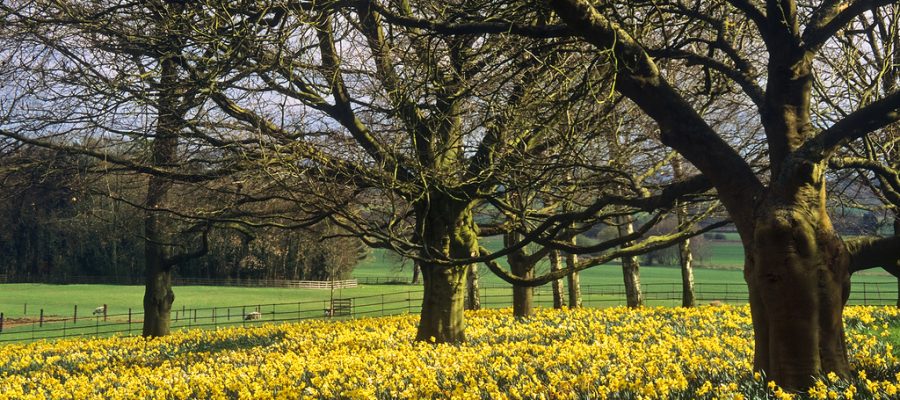
In general, if your trees are deciduous, choose early flowering plantstherefore they will benefit from the sun before the leaves of the plants appear above them.
Waterfall
The second criterion to take into consideration when this type of system is water. First of all, why large trees absorb a large amount of water and this is to the detriment of the plants with which they compete. After, rainwater does not always reach ground level due to the high branches, which accentuates the effect of drought on this type of place.
It will therefore be necessary to encourage plants that do not require too much water live or even drought resistant plants. In all cases it will be necessary to water well when planting to facilitate recovery and monitor, during the hot months, that the plants do not suffer too much, otherwise it is necessary to provide water. It is also necessary to plan significant planting holesabout double the size of the root ball or pot so the roots have room to start. Make these plantings between large tree roots that must not be damaged.
There is, however, an exception to this problem: if your trees are at the bottom of an embankment, there is a good chance that rainwater will run off and therefore be beneficial to your plantings.
Nutrients
The problem with nutrients is more or less the same as with water: large trees have large demands and this is to the detriment of young plants. At the time of sowing, bring compost and fertilizer in the holes so that the new seedlings have everything they need to grow again. So, don’t hesitate to spread a specific fertilizer every year for the plants you have planted (shrubs, perennials, etc.).
However, avoid plants that have excessive nutrient requirements.
The worst situation still remains to plant under conifers: they have, in most cases, dense foliage that provides powerful shade and their needles or scales that fall to the ground acidify it, which further reduces the choice of plants that support it.
The choice of plants
Now we have the main criteria for choosing plants. I’ll summarize them for you and provide some other information:
- The type of plants : avoid planting plants that will grow too large. They risk finding themselves in competition with the lower branches of the trees and, in most cases, the larger a plant is, the greater its need for water and nutrients, whereas in this situation these elements are lacking. So I prefer it small shrubs, ground covers, perennials and bulbs. You can also place annual plants but these will need to be renewed regularly.
- The light : Depending on the number and type of shade trees, choose loving plants partial shade or shade. Take light-loving plants only if a single tree obscures the area. If possible, promote early flowering plants so that they can benefit from the sun when they need it most and before the leaves of the trees emerge.
- Waterfall : favor plants that do not consume too much water and that are able to withstand periods of drought.
- Nutrients : take the plants that they do not require too rich soil.
- So, these are the classic criteria in choosing plants: the robustness depending on the strength of frosts in your region and your lands especially if specific (calcareous, acidic, very draining, etc.).
- And finally, last important criterion: get the plants you like! Choose a few in colors you like, both in terms of flowers and leaves. If possible, vary between deciduous species (which lose their foliage in winter) and evergreen species.
By making a list of criteria suitable for your situation, you will be able to select the plants that match you in the nursery and garden center. You can also do it on search engines for online plant sales sites.
latest posts published
The Magic of Flowers from Seeds: How to Grow Beauty from Scratch – Home & Family > Plants
The most beautiful autumn flowers. Perennial plants to have in the garden – Home and family > Plants

Sunflower, romantic and seductive – Home and family > Plants
Plants with good Feng Shui – Home and family > Plants

Which vegetables grow the fastest? 10 varieties to have in the garden – Home and family > Plants
Dwarf roses: color and freshness – Home and family > Plants

How to make potted lilacs last longer – Home and family > Plants
Bayer plants for a green future! – Home and family > Plants
Trees with good Feng Shui – Home and family > Plants