Choosing the right floor covering is an important planning step during the construction of a house. After all, the floor contributes decisively to the comfort of the room. In addition to aesthetic aspects, practical factors should also be taken into consideration. The floor covering in the living room must meet different needs than that in the bathroom. The so-called usage and abrasion classes play an important role here, especially to prevent premature wear. But as a layperson you often don’t know what the various key figures are saying. We bring light into the darkness and have a global vision Overview of all relevant usage classes and abrasion groupscompiled.
Floor use classes
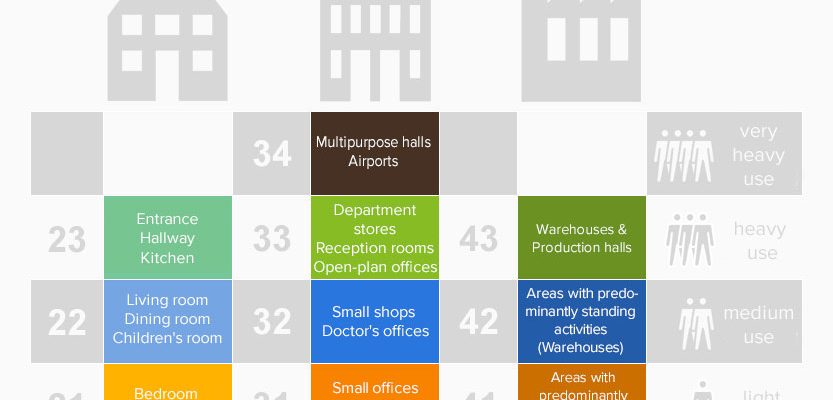
Anyone who is building a house or wants to renovate their home will sooner or later have to face the question of the right flooring. Here you should first get acquainted with the quality technical characteristics. These are the so-called usage classes for laminate, elastic and textile floors. These indicate what type of load intensity the floor is suitable for. They also provide information on which rooms the respective floor coverings should be used. The norms for the usage classes are set out in DIN EN ISO 10874. The basic rule here is:
- Classes 21, 22 and 23 indicate floors suitable for private use
- Flooring for commercial use they are marked with classes 31, 32, 33 and 34
- The classification 41, 42, 43 and 44 concerns floors for the industrial use provided
The second numbers from 1 to 4 indicate the different levels of resilience. This results in the following division:
- 21, 31, 41 indicate one moderate use
- 22, 32, 42 indicate one medium usage
- 23, 33, 43 indicate one intense use
- 24, 34, 44 indicate one very intense use
Classes of use – private use (residential)
You can interpret the usage classes in the private sector as follows:
- Use class 21 – suitable for bedrooms or guest rooms
- Suitability for use class 22 – for living room or dining room
- Use class 23 – suitable for corridors, stairs, bedrooms or kitchens
Use classes – commercial use (work)
In the commercial sector you can use the following recommendations as a guide:
- Die Use class 31 it is particularly suitable for offices
- floors of Use class 32 they are recommended for single offices and service rooms
- floor coverings Use class 33 it will be for example B. used in the hotel industry
- Die Use class 34 can be found for example B. at airports or department stores
Abrasion classes for laminate floors
In addition to the usage classes, the abrasion classes of laminate floors should not be overlooked. These in turn indicate the wear resistance of the floor.
Abrasion courses for laminate floors – private use
Similar to the usage classes, a distinction is made here between private and commercial use. Therefore the following abrasion classes are suitable for private use:
Laminate flooring abrasion classes – commercial use
In the commercial sector the following abrasion classes are recommended:
- AC4 – offices, boutiques, but also private living areas
- AC5 – busy retail stores, restaurants
- AC6 – Airport, community
Abrasion groups on tile coverings
What the use classes represent for laminate are the abrasion groups for tile coverings. The classification mainly indicates the speed with which the surface of a tile wears out. This in turn depends on several factors. On the one hand, the type of tile plays an important role. Unglazed tiles have practically no restrictions on use. Glazed tiles, on the other hand, are much more sensitive. On the other hand, it depends on the respective space. This results in five abrasion classes:
Abrasion group 1 – least resistant
The surface of abrasion group 1 tiles is very sensitive to scratches and not very resistant to abrasion. Floor coverings from this abrasion group are best suited for the bedroom or bathroom. In other words, for rooms entered with soft-soled shoes and with little foot traffic.
Abrasion group 2 – light wear
The tiles in abrasion group 2 can be walked on with normal footwear and are generally more resistant to scratches. Tiles of this classification are suitable for example for the living area.
Abrasion group 3 – medium load
Abrasion group 3 floor coverings can be used safely in frequently frequented environments. So for example. B. in the living area, in the corridor or on the balcony or in the loggias.
Abrasion group 4 – more intense use
Abrasion group 4 is suitable for the most frequented environments, such as in the kitchen, in the entrance or on the terraces.
Abrasion group 5 – heavier wear
Abrasion group 5 tiles are used less often in private areas and more often in commercial areas.
latest posts published

The Magic of Flowers from Seeds: How to Grow Beauty from Scratch – Home & Family > Plants

The most beautiful autumn flowers. Perennial plants to have in the garden – Home and family > Plants

Sunflower, romantic and seductive – Home and family > Plants
Plants with good Feng Shui – Home and family > Plants

Which vegetables grow the fastest? 10 varieties to have in the garden – Home and family > Plants
Dwarf roses: color and freshness – Home and family > Plants

How to make potted lilacs last longer – Home and family > Plants

Bayer plants for a green future! – Home and family > Plants
Trees with good Feng Shui – Home and family > Plants