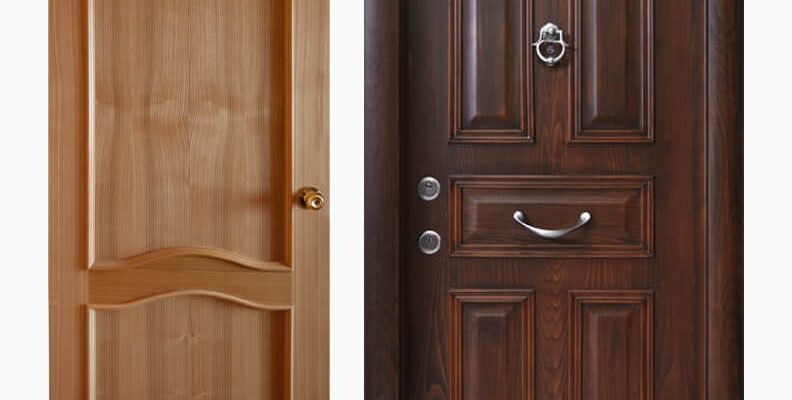
Everyone has their own preferences when it comes to doors in living spaces. Some like them open, others closed or at least ajar. Room doors contribute visually to the interior design, but above all their function is fundamental. Here you can find out which types of interior doors you can choose when building a house with Rötzer and how they differ in material and function.
Tip from the pro: It is best to plan the installation of interior doors using the floor plan. We’ll tell you how to best approach this problem in our blog post “Plan a House Floor Plan: With These Tips Your Planning Will Work!”
Types of interior doors by material
Doors with CPL surface
If among the many types of internal doors you are looking for a particularly robust variant, plastic doors are the best choice. CPL (Continuous Pressure Laminate) interior doors are made of impregnated cellulose fibers that are continuously pressed together with thermosetting synthetic melanin resin. Their surface thickness reaches up to 40 mm. HPL (High Pressure Laminate) doors are made of the same material, but have a maximum surface thickness of 15 mm. Both variants score points for their durability. They are scratch and abrasion resistant, heat and UV resistant and are easy to clean thanks to their smooth surface. They are therefore particularly suitable for public buildings with intensive use of doors, such as offices.
At Rötzer we offer interior doors with a CPL surface as standard
Our internal doors are covered in CPL as standard. The surface design is freely selectable. You have the choice between:
- Opaque white ash
- Touch the white oak
- Touch the oak cream
- Touch the nature of oak
- Touch the white line
- Tap the gray line
- Touch the oak
The interior doors (nominal height approx. 2.12 m) are all equipped with handle sets made of stainless steel or aluminum (e.g. Hoppe or other manufacturers). Toilet and bathroom doors are equipped with a set of slotted heads/olives. When building a house with a basement, the aforementioned door elements are also installed in the basement (nominal height approx. 2.01 m).
We work together with the reliable manufacturer Sühac, whose doors convince in both function and appearance. Upon request we can also install internal doors in «white lacquer» or glass. Don’t hesitate to talk about it with us.
Glass doors
There are many different types of interior doors. However, glass doors always have a very special effect in interiors. In general, a distinction is made between all-glass doors and doors with inserted glass. In both cases it is important to use safety glass to avoid accidents caused by glass shattering. Interior glass doors generally offer moderate sound insulation and require a lot of cleaning as stains and marks are visible on them. But they allow for better exposure. Particularly small rooms without windows can not only benefit from the light from adjacent rooms, but can also be visually enlarged with the help of a transparent door. If you want to maintain privacy despite a glass door, you should choose a semi-transparent or frosted pane. Glass doors can also be made as sliding doors.


Types of internal doors by function
Soundproof doors
Concentrated work or learning requires peace and quiet, which is not always possible in a home. Especially if you have small children who sleep during the day or roommates who regularly listen to music, it is worth installing a door with good soundproofing properties. This basically performs two functions: it keeps the noise in the room where it is generated, or it keeps the noise out of a room. When soundproofing an interior door, always pay attention to its intended purpose. In soundproof doors, the bending softness and mass determine the sound insulation class of the door. Single-layer door leaves offer less sound insulation than multi-layer doors. The soundproof doors are also equipped with a frame seal and base seal. However, interior doors can also be transformed into soundproof doors, for example with a sound absorbing pad on the door leaf or sealing elements on the frame and bottom.
Sliding doors
Sliding doors, also less commonly called sliding doors, do not require a swing area to open, making them a space-saving alternative to conventional doors. Depending on the model, a sliding door can slide in front of or into the wall, and the latter option allows it to completely “disappear” from view. Sliding doors are particularly suitable between two rooms that can be connected or separated as desired, such as the kitchen and the living room or dining room. For most doors of this type a side guide is not necessary. They can also be equipped with a soft closing mechanism. This slows down the sliding door when it opens so that it does not hit, but slides smoothly to the end.

Windproof hatches
If you want to separate the entrance area from the living area, a door with a vestibule element is recommended. This usually consists of two side panels and, if the ceiling is high, also a skylight. Since the entrance doors consist of framed glass panels, they also function excellently as room dividers, while allowing for an open, light-flooded architecture. The frame material can be freely chosen, so that even the apse can be adapted to the interior design.
A visit to our sampling center is an integral part of home planning with Rötzer. In our showroom you will be able to see the different interior doors live, touch the materials and compare the finishing options.
latest posts published

Create an insect hotel in your garden

Find out which lighting to use for each part of your garden

Make a modern fire pit yourself

[Photos] Roof garden terraces

Wooden terrace: which species to choose?

The 10 essential aromatic plants for your garden

4 questions to ask yourself before creating a pond in your garden

My selection of 15 plants with purple foliage
Which natural stone to choose for the flooring of your terrace?