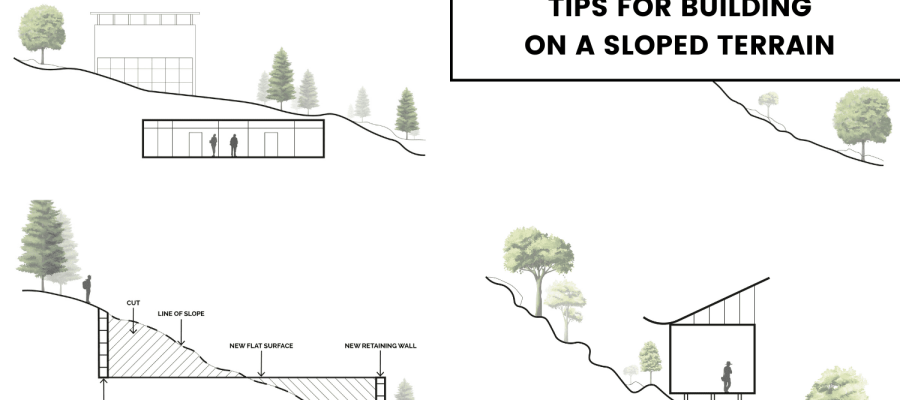
You’ve been looking for it for a long time and now you’ve finally found it: the perfect place for your dream home. But what to do if the property you want is not on the ground floor? What should builders pay attention to when building a… Building on a hilly property Want? We have them for you five most important points summary.
1) What lies beneath the surface? A professional subsurface report is a must!
Before you decide to build on a sloping property, you should Check the surface carefully allow. With a subsoil survey from an expert you will quickly know whether the land is generally suitable for building a house. This report also provides information on how The foundation and development of the hillside property is complex it will be later. Both rocks that are too hard and layers of earth that are too soft can pose challenges that require additional construction work.
2) Sun worshipers or shade providers: Which direction does the sloping property face?
Before building on a sloping property, you should consider the properties there Lighting conditions check. It is preferable to visit the property at different times of the day. On a north-facing slope you can expect less direct sunlight and longer shadows than on a south-facing slope. That’s why builders should find out before starting construction on a north-facing slope what development is still possible above their sloping property. Buildings in this location easily cast shadows of 30 meters or more.
Depending on the orientation of the building land, the construction measures to be considered also change:
- Is it necessary to install additional lights in the property on a north facing slope?
- Should the lack of light on the north side be compensated for by larger windows?
- The use of e.g. B. Photovoltaic systems possible?
- What shading measures are necessary on a very sunny south-facing slope?

3) If you are building on a sloping property, water can become a major problem
If the sloping property is suitable for development, particular attention must be paid during the construction phase Movement of water in the earth be respected. As soon as water appears in the excavation, the work must be stopped. It is important to restore the balance of soil conditions by filling the soil. If in doubt, it is advisable to consult an expert. Although these delays in construction work are annoying for the builder and the construction company, they are inevitable, for example, due to the potential instability of the ground. B. to prevent landslides.
After the house was built, the so-called Suspended washing machine damage the building. The layer of water that often forms when it rains runs down the slope and can accumulate on the exterior walls of the slope side. If the pressure is excessive, water penetrates the masonry and causes serious damage. It is therefore important to pay attention to the regulations DIN 18531 to DIN 18535 if you are building on a sloping property. These standards specify the building seals that must be respected. Find out which ones in advance Drainage methods they are suitable for your sloping property.
4) The location of the sloping land determines the complexity of the construction site setup
Setting up a construction site on a flat surface is usually much easier than on a slope. But there are also differences on sloping properties: Is your property above or below the access road? If it is less, you will benefit from: B. street drainage, so you have fewer problems with sloping water during the construction phase. This saves some safety work steps when setting up the construction site and thus saves time and money. Furthermore, it always depends on the steepness of the slope which measures to take against landslides. Also ensure that the access road to the property is suitable for large, heavy construction vehicles.
5) The best for last: what type of house do you choose?
If you build on a hillside property, you have the opportunity to have exceptional architecture and beautiful views. This is why there is no «typical» hill house. You can choose between different construction methods:
- The house with the excavation:
Part of the slope side is removed to give the building a solid footing. Rooms surrounded by land can often be used as a cellar or garage. These parts of the house benefit from natural insulation through the ground by being “buried”. - On two levels – when the floor plan adapts to the slope:
If you like something a little more extravagant, the split-level design might appeal to you. Here the architecture takes advantage of the sloping height of the slope. The different floors are moved relative to each other, resulting in special room layouts with few or no corridors. Height differences between rooms must be overcome with a relatively large number of stairs. - All one floor higher with the stilt house:
If the slope of the land is very steep, making the two construction methods just described very complicated or simply impossible, then the house can be built on stilts. The pillars can be made of concrete, steel or wood and raise the ground floor by an entire floor.
Is it worth building on a sloping property?
There is no denying that it is more complicated to build a house on a slope than on a flat surface. However, the construction project requires good preparation and a competent construction partner also to be mastered with great success at his side. If you want to build on a sloping property, get help from professionals promptly, so that your dream home is as perfect as you imagine it.
latest posts published

The Magic of Flowers from Seeds: How to Grow Beauty from Scratch – Home & Family > Plants

The most beautiful autumn flowers. Perennial plants to have in the garden – Home and family > Plants

Sunflower, romantic and seductive – Home and family > Plants

Plants with good Feng Shui – Home and family > Plants

Which vegetables grow the fastest? 10 varieties to have in the garden – Home and family > Plants

Dwarf roses: color and freshness – Home and family > Plants

How to make potted lilacs last longer – Home and family > Plants
Bayer plants for a green future! – Home and family > Plants
Trees with good Feng Shui – Home and family > Plants